


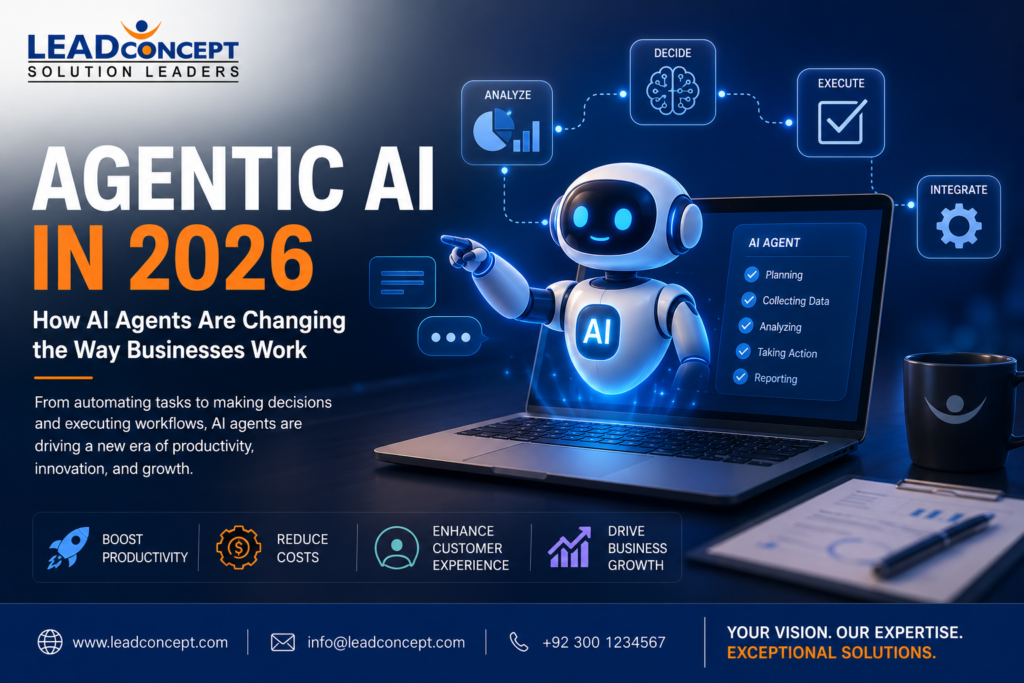
Agentic AI in 2026: How AI Agents Are Changing the Way Businesses Work
Artificial Intelligence has moved far beyond chatbots that simply answer questions.
In 2026, businesses are increasingly exploring AI agents—systems that can understand a goal, plan multiple steps, interact with software and data, and take action with limited human intervention.
That shift is changing how companies think about automation.
Instead of using AI to complete one small task, businesses can connect AI agents to entire workflows, allowing them to handle repetitive processes while employees focus on strategy, creativity, and decision-making.
According to Google Cloud’s 2026 AI Agent Trends report, AI agents are expected to reshape productivity, customer experience, . security, and complex business workflows.
But there is an important distinction: adding an A.. bot to your website isn’t the same as building an agentic system.
What Is Agentic AI?
Traditional AI generally responds to a prompt.
For example:
“Write an email to this customer.”
An AI agent can go several steps further.
You could give it a goal such as:
“Follow up with qualified leads from this week’s CRM records.”
The agent could potentially identify the leads, review relevant information, prioritize them, draft personalized messages, update the CRM, and request human approval before sending.
That’s the fundamental difference.
AI generates an answer. Agentic AI can execute a workflow.
Modern AI agents can combine reasoning, planning, memory, tools, APIs, databases, and business rules to accomplish multi-step objectives.
Why Businesses Are Paying Attention to AI Agents
The interest in agentic AI isn’t simply about having a more advanced chatbot.
It’s about reducing the amount of manual work required to move information and decisions through an organization.
For example, an AI-powered workflow could help:
Sales Teams
- Qualify incoming leads
- Research prospects
- Update CRM records
- Prepare follow-up messages
- Schedule meetings
Customer Support
- Classify incoming requests
- Search the knowledge base
- Recommend solutions
- Escalate complex cases
- Update support tickets
Operations
- Process documents
- Extract information
- Generate reports
- Monitor workflows
- Trigger actions across business applications
Finance
- Organize invoices
- Identify anomalies
- Prepare financial summaries
- Assist with reporting
- Automate routine administrative workflows
The opportunity is particularly interesting because AI agents can interact with existing business systems rather than operating as isolated tools.
AI Agents vs. Traditional Automation
Traditional automation usually follows predefined rules:
If A happens → perform B.
That works extremely well when processes are predictable.
Agentic AI becomes more useful when workflows involve unstructured information, changing conditions, or multiple decisions.
For example:
Traditional automation:
New form submission → Send confirmation email.
Agentic workflow:
New form submission → Analyze the request → Determine customer intent → Check CRM history → Prioritize the lead → Prepare personalized response → Update CRM → Notify sales representative.
The second workflow involves interpretation and decision-making rather than simply following one fixed rule.
That doesn’t mean AI agents should operate without oversight. In fact, governance is becoming one of the biggest challenges surrounding agentic AI. Deloitte reported in 2026 that only 21% of surveyed organizations had mature governance for managing agentic AI risks.
Where Agentic AI Can Create Real Business Value
The best AI implementation isn’t necessarily the most sophisticated one.
A practical approach is to identify repetitive, time-consuming workflows where AI can produce measurable improvements.
For example:
Lead Qualification Agent
An agent reviews incoming leads, identifies relevant information, scores prospects, and routes qualified opportunities to the appropriate sales team.
Customer Service Agent
An AI agent can understand customer requests, retrieve information from approved knowledge sources, and assist with resolving common issues.
Internal Knowledge Agent
Employees can ask questions about company policies, documentation, products, or procedures and receive answers based on approved internal information.
Document Processing Agent
AI can extract information from invoices, applications, contracts, forms, and other documents and pass structured information into business systems.
Reporting Agent
An agent can collect information from multiple systems, analyze it, and prepare recurring business reports for human review.
These use cases don’t require replacing employees.
They are about giving employees intelligent digital assistance that can handle repetitive work at scale.
The Biggest Mistake: Building AI Without a Business Case
AI adoption is accelerating, but not every business problem requires an AI agent.
One of the biggest mistakes companies can make is starting with:
“We need an AI agent.”
Instead, start with:
“What business problem are we trying to solve?”
Then evaluate whether AI is the right technology.
For example, if a process can be solved with a simple API integration or traditional automation, building a complex AI system may create unnecessary cost and complexity.
AI should be introduced where it provides a genuine advantage.
This is also becoming increasingly important as businesses scrutinize the cost of running AI systems. Recent reporting has highlighted rising AI infrastructure and token costs associated with autonomous agents, making efficient architecture and appropriate model selection increasingly important.
How to Prepare Your Business for Agentic AI
If you’re considering AI agents, start with these five steps:
1. Identify Repetitive Workflows
Look for processes that consume significant employee time and involve repetitive decisions or information handling.
2. Define the Desired Outcome
Don’t begin with the technology. Clearly define what success looks like.
3. Connect the Right Data
AI agents need access to accurate, relevant business information to make useful decisions.
4. Build Human Oversight
Not every action should be autonomous. Sensitive financial, healthcare, legal, or customer-facing decisions may require approval.
5. Measure ROI
Track metrics such as:
- Time saved
- Cost reduction
- Response time
- Conversion rate
- Customer satisfaction
- Employee productivity
The objective isn’t simply to deploy AI.
The objective is to create measurable business value.
The Future Is Not Just AI-Powered—It’s AI-Connected
The next phase of AI development will likely involve deeper integration between AI models, business applications, databases, APIs, and human teams.
Instead of opening ten different applications to complete a workflow, employees may increasingly delegate portions of that workflow to intelligent systems.
Research and industry reporting in 2026 show that organizations are actively pursuing this transition, although many are still struggling to move from experiments and pilots into reliable production systems.
That creates an important opportunity for businesses.
The companies that benefit most from AI won’t necessarily be the ones using the most AI.
They will be the ones that identify the right problems, build the right workflows, and implement AI responsibly.
Build Your AI Strategy with LEADconcept
At LEADconcept, we help businesses move beyond AI experimentation and develop practical digital solutions designed around real business requirements.
Our team can help you explore opportunities for:
- Custom AI Development
- AI Agents & Intelligent Automation
- AI Chatbots
- Generative AI Applications
- AI-Powered SaaS Products
- Business Process Automation
- AI API Integration
- Custom Software Development
Whether you’re looking to automate an internal workflow, improve customer service, develop an AI-powered product, or integrate intelligent capabilities into existing software, the first step is understanding where AI can create the most value.
Have an AI idea?
Let’s turn it into a practical, scalable solution.
Talk to LEADconcept’s AI Development Team